
Clarion County Criminal Court Cases
Clarion County is Pennsylvania's 18th Judicial District. A criminal complaint normally starts before a Magisterial District Judge, or MDJ. That judge handles the preliminary arraignment, considers bail in most cases, and may hold a preliminary hearing. Traffic, nontraffic summary, and other limited matters can remain at that level. When a felony or misdemeanor is held for court, the prosecution moves to the Clarion County Court of Common Pleas.
The Clerk of Courts is the chief record keeper for Common Pleas criminal proceedings. Its criminal counter is at 421 Main Street, Suite 25, Clarion, PA 16214. The direct line is 814-226-1119. The clerk records filings, verdicts, judgments, and court financial obligations. Police narratives and current jail bookings remain with other custodians, so a court file should not be treated as a complete police or custody record.
Clarion's Three Criminal MDJ Districts
A January 2024 realignment eliminated district 18-3-01. Current searches should use districts 18-3-02, 18-3-03, and 18-3-04. Older directories that still list 18-3-01 are stale. The county's official MDJ directory is the best place to verify which office serves a municipality.
District 18-3-02 is listed at 22 North Sixth Avenue, Suite B, Clarion, with 814-226-9355. District 18-3-03 is at 200 Mendenhall Avenue, Knox, with 814-797-5934. District 18-3-04 is at 237 Broad Street, New Bethlehem, with 814-275-2322. Jurisdiction matters because a lower-court docket can contain early case events that are not obvious from the later Common Pleas result.
The source page shows how the county divides lower-court access. That structure also explains why one broad search can miss the first part of a prosecution.
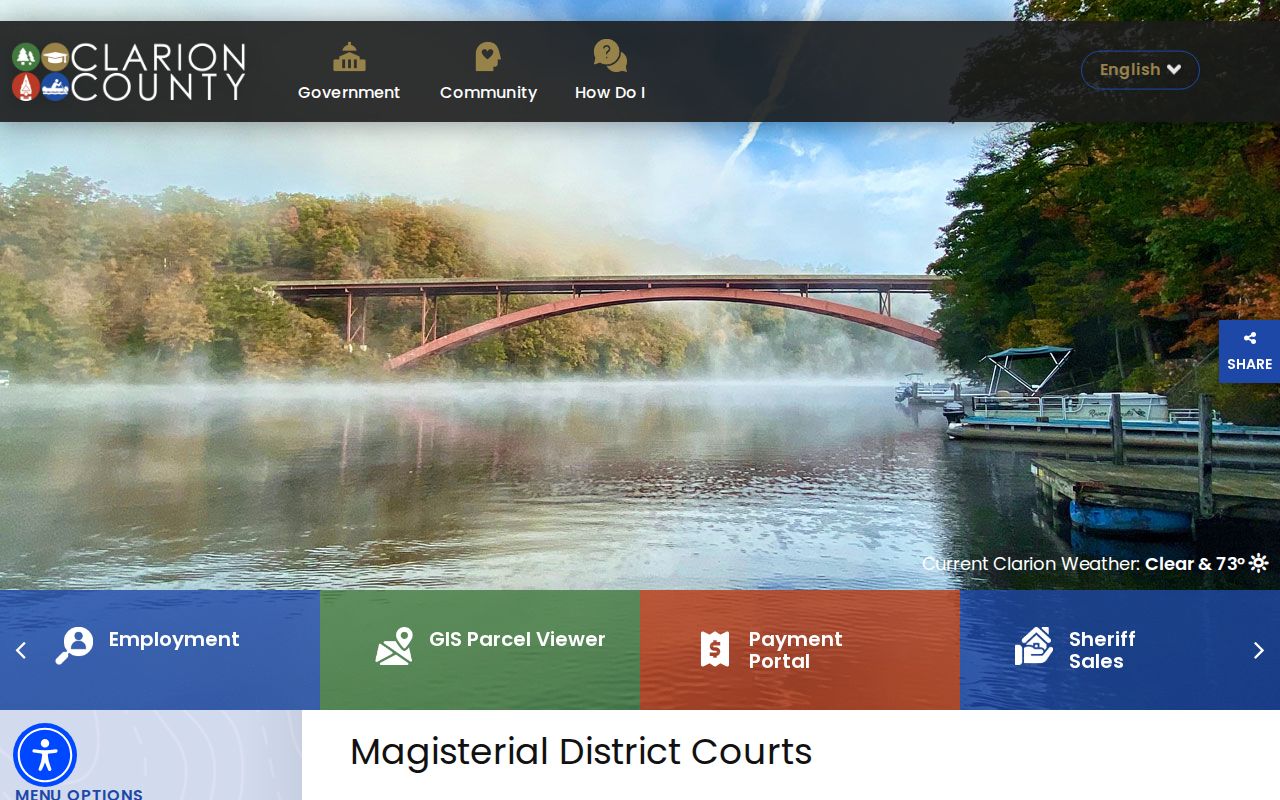
The directory connects each local counter to the lower-court docket that office maintains.
Searching Clarion County Case Records
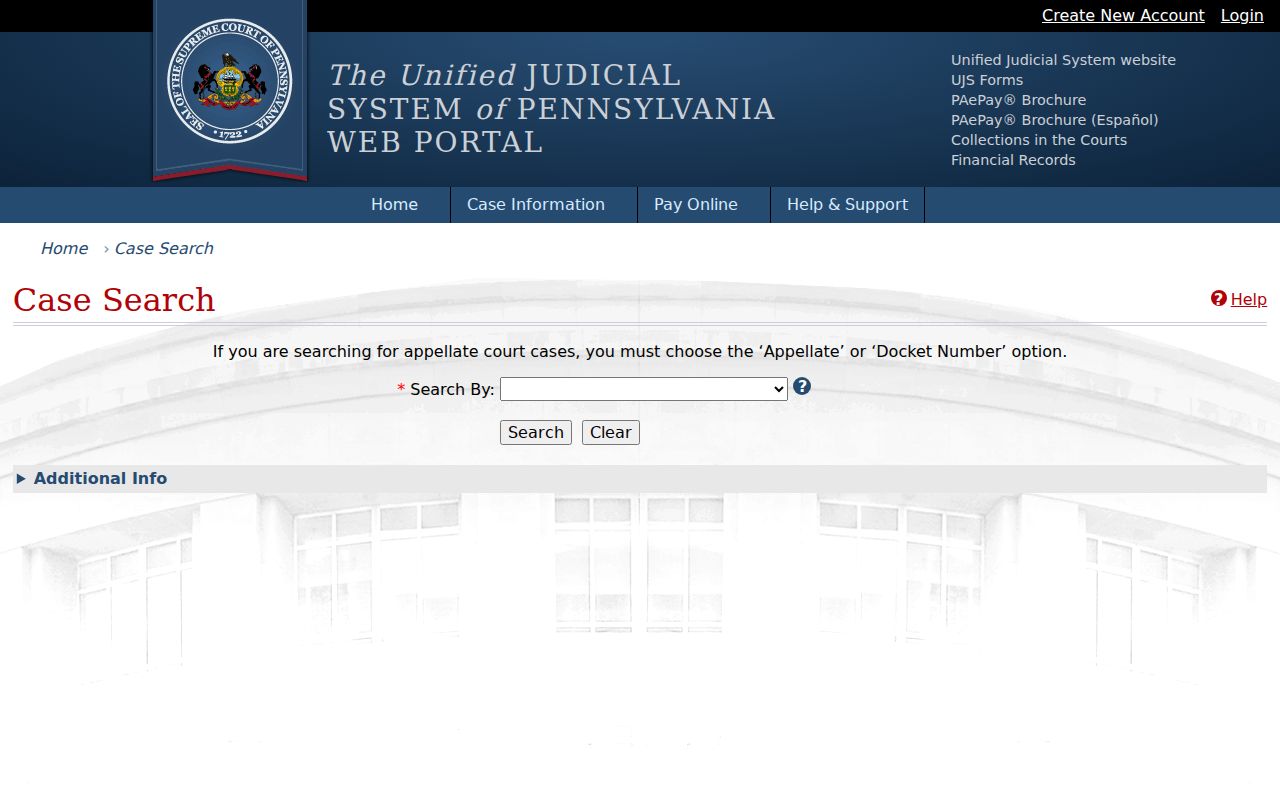
The free Unified Judicial System Case Search supports participant-name and docket-number searches. Search Common Pleas and MDJ records separately. Confirm identity from the public case details rather than relying on a same-name match. CAPTCHA or terms may gate the public form, and automated bulk use is not authorized.
- Choose Participant Name when no docket number is known.
- Select Common Pleas or Magisterial District Courts, then narrow to Clarion County.
- Enter the legal surname and add a first name, filing range, or status when useful.
- Open the docket sheet and compare the court, filing date, charges, OTN, and linked dockets.
- Ask the Clerk of Courts for a public filing or certified copy that is not downloadable.
| Search field | Use | Important limit |
|---|---|---|
| Search Type | Participant Name or Docket Number | Pick the route that matches the identifier |
| Court Type | Common Pleas or MDJ | Search both for a full local path |
| County | Select Clarion | Leaving it broad returns statewide results |
| Name | Last name, then first and middle | A name alone does not prove identity |
| Docket Number | Segmented Pennsylvania format | Must match the court and year |
| Date Filed or Status | Narrow a large result set | Availability varies by search type |
The official interface illustrates the statewide search used for Clarion County criminal cases. Its filters are aids, not substitutes for checking the docket itself.
Reading Clarion Criminal Docket Numbers
Common Pleas criminal docket numbers begin with CP-16-CR, followed by a case sequence and year. The county code is 16. A lower-court number beginning MJ-18302-CR identifies MDJ 18-3-02. A linked docket and the same offense tracking number, or OTN, can help connect the early complaint to the later prosecution. Search results may show both numbers even though the court files cover different stages.
Do not assume that every charge remains the same. Police allegations can change after review, and the Common Pleas information may differ from the original complaint. Grade codes such as F1, F2, F3, M1, M2, M3, S, and ungraded describe the charge classification. They do not, by themselves, state the result. Read the disposition row and sentence entries before drawing a conclusion.
Bail fields also need context. The sheet may report bail type, status, amount or percentage, posting data, and surety details. Bail governs release while a case is pending. It is not punishment or the final result. Scheduled-event rows can change, so confirm a hearing with the court instead of relying on an old download.
Inside a Clarion County Case File
A public docket is a structured case history. It can identify the court, case status, filing date, attorneys, judge, bail, charges, events, disposition, and sentence. A downloadable docket sheet does not mean that every complaint, motion, order, exhibit, or transcript is online. The clerk decides access to the filed Common Pleas material under court rules and sealing orders.
| Docket and court | Caption, county, status, initiation date, and linked lower-court docket |
|---|---|
| Case identifiers | OTN, police incident or complaint number, and arresting agency |
| Charges | Statute, description, grade, counts, and offense date |
| Bail | Type, status, amount or percentage, posting date, and surety data |
| Events | Dated filings, hearings, scheduled proceedings, and responsible judicial officer |
| Outcome | Disposition, judge, sentence, confinement, probation, credit, and financial terms |
The Clarion Clerk's Counter
The Clarion County Clerk of Courts is the fallback for an older filing or public document not offered through the portal. Provide the defendant's name, docket number when known, approximate year, and a clear description of the item. Ask about access, current copy or certification charges, and mail delivery before sending payment. No current official criminal-copy fee schedule was located in the research.
Criminal financial obligations may be paid by cash, check, or money order payable to Clarion County Clerk of Courts. Mailed payments need the docket number, and the office requests a stamped return envelope for a receipt. The county also links PAePay, but not every case cost can be paid there.
The official clerk page identifies the proper criminal-record counter. It is not a substitute for an arresting agency's report desk.
How a Criminal Case Moves
A complaint begins the public prosecution. The preliminary stage tests whether the case should continue, while the Common Pleas stage holds the formal filings and final county judgment. Timing varies with bail, motions, continuances, plea talks, trial scheduling, and the needs of each case. No fixed local timetable should be inferred from the docket format.
Case flow: Charges Filed › Arraignment › Pretrial › Plea or Trial › Disposition › Sentencing
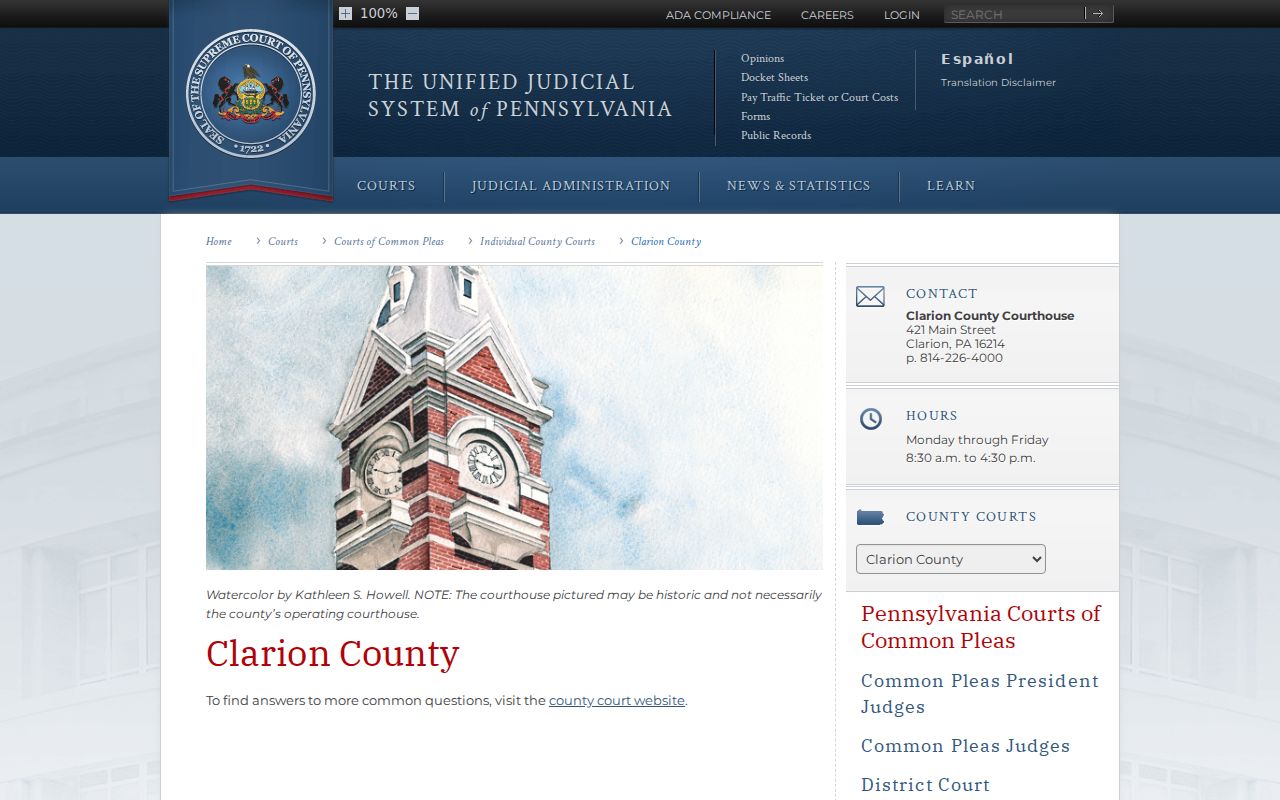
The Pennsylvania courts profile for Clarion County confirms the county court within the statewide system. This is useful when distinguishing the trial court from a lower MDJ office.
PAePay and Clarion Court Costs
PAePay is a payment tool, not a case-record search or a full ledger. First read the docket and confirm the obligation. Then check whether the payment is eligible online. A balance may include fines, costs, restitution, or a plan, and the public docket can lag behind office accounting.
The official PAePay interface is linked by the Clerk. Contact Suite 25 when the system does not accept a listed obligation or when a receipt must be tied to a mailed payment.
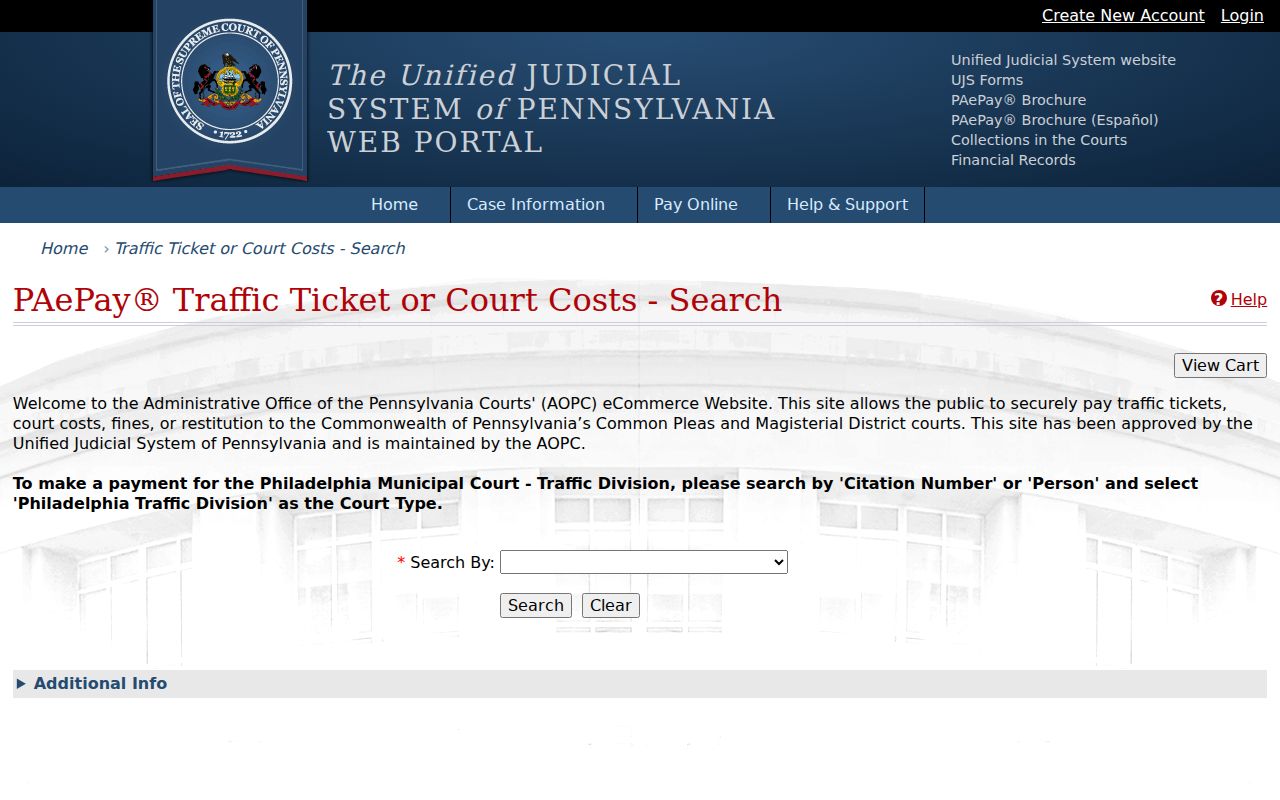
This payment screen belongs after docket review, since availability does not establish the case outcome.
Clarion Court Records Survived Fires
Clarion's courthouse history gives older records an unusual local context. The first courthouse burned in March 1859, yet the county reports that all records were preserved. The second courthouse burned in September 1882, and the official account again says no records were lost. Churches and the Arnold block housed court work until a permanent home returned.
The present courthouse was accepted in 1885. Later projects repaired its tower, windows, and interior without ending its role as the county's court center. That history does not mean each old filing is online. It explains why researchers may need the clerk for a paper or archived record even though newer docket facts appear through UJS.
For an older criminal case, provide a name, approximate year, and any docket clue. Ask whether an index entry, docket sheet, or particular public filing is available. Family-history work may take more effort than a recent docket-number request, and certification should be ordered only when an official copy is needed.
Clarion Case Access and Restrictions
Open docket facts can coexist with restricted filings. Juvenile records, sealed matters, limited-access cases, protected victim data, and sensitive identifiers may be absent or redacted. Clean Slate limited access can make a case unavailable to a general public search without destroying every agency record. A missing result therefore does not prove that no proceeding existed.
Try spelling variants, both court levels, and a docket-number search. For older material, call the filing office. The courthouse survived two historic fires without losing its records, according to county history, but older holdings still may not be downloadable. Requests for police narratives belong with the agency that created them. A PATCH criminal-history check is also a separate repository product, not a substitute for the court file.
A clerk request should name the exact filing sought. Ask whether inspection will answer the question before ordering copies, and state at the outset if certification is needed. Staff can explain access and office procedure, but they cannot interpret the legal effect of an order.
Note: Court dockets report allegations and outcomes; an unresolved charge is not proof of guilt.